


CO₂ Fractional Laser Machines From China For Scar Removal
Oct 29, 2026
Leave a message
CO₂ fractional laser machines are widely used in professional skin resurfacing procedures, including treatments designed to improve the appearance of acne scars, uneven skin texture, and certain other types of scars. For dermatology clinics, aesthetic centers, and medical spas, choosing the right equipment involves more than comparing prices. Laser performance, treatment flexibility, safety features, and supplier reliability all deserve careful consideration.
China has become an important sourcing destination for aesthetic equipment buyers looking for a range of CO₂ fractional laser systems, customization options, and wholesale cooperation. However, product quality, technical specifications, and regulatory documentation can vary significantly between suppliers.
1. How Does a CO₂ Fractional Laser Machine Work?
A CO₂ laser typically operates at a wavelength of 10,600 nm. Its energy is strongly absorbed by water in tissue, allowing controlled ablation and thermal effects during skin resurfacing procedures.
A fractional CO₂ laser delivers energy in a pattern of microscopic treatment zones rather than treating the entire surface uniformly. Untreated areas remain between these zones, supporting the skin's healing process.
Compared with traditional full-field ablative resurfacing, fractional treatment can offer a different balance between treatment intensity, recovery, and risk. However, fractional CO₂ laser procedures still involve tissue injury and require appropriate patient selection and aftercare.

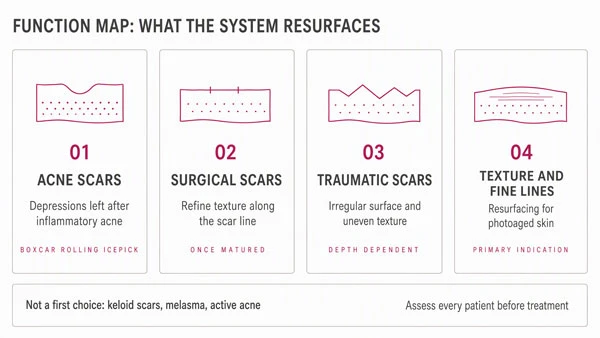
2. What Types of Scars Can Fractional CO₂ Lasers Treat?
When evaluating a CO₂ fractional laser machine for scar removal, it is important to understand which treatment applications are supported by the specific device.
Atrophic Acne Scars
Atrophic acne scars appear as depressions in the skin after inflammatory acne. They include rolling scars, boxcar scars, and ice-pick scars.
Fractional CO₂ laser resurfacing may improve the appearance of some atrophic acne scars by removing microscopic portions of tissue and stimulating collagen remodeling. Results vary by scar type, and deep or narrow scars may require alternative or combination treatments.
Surgical Scars
Some surgical scars may benefit from fractional laser resurfacing, depending on their maturity, thickness, texture, and location. Treatment planning should take into account wound healing, scar characteristics, and the risk of pigment changes or further scarring.
Traumatic Scars
Scars resulting from injuries may have irregular texture or surface depressions. Selected scars may improve with laser resurfacing, but suitability depends on the depth and structure of the scar.
Other Skin Texture Concerns
Depending on the machine's intended use and applicable regulatory authorization, fractional CO₂ systems may also be used for certain skin resurfacing procedures involving textural irregularities and fine lines.
Important: Fractional CO₂ laser treatment is not suitable for every scar. Raised hypertrophic scars and keloids require different clinical considerations, and laser resurfacing may be inappropriate in some cases. Qualified practitioners should assess each patient before treatment.
3. Key Features to Compare When Buying a CO₂ Fractional Laser Machine
Not all machines offer the same treatment capabilities. Before purchasing from a Chinese manufacturer, request detailed specifications and compare the following features.
Laser Output and Energy Control
Ask for the machine's rated output, pulse characteristics, energy settings, and operating modes. Confirm what each specification measures and how it relates to the device's intended use.
Avoid selecting a machine based solely on its advertised wattage. Output power alone does not establish treatment effectiveness or safety.
Fractional Scanning Patterns
The scanner determines how microscopic treatment spots are distributed across the treatment area. Depending on the system, different patterns and adjustable coverage settings may be available.
Review the supported patterns, spot distribution, scan dimensions, and adjustment options. The scanner should be appropriate for the procedures your clinic intends to provide.
Treatment Modes
Some CO₂ laser systems support fractional resurfacing as well as other modes, such as continuous or pulsed output for different applications.
Additional modes may expand a clinic's service options, but they should be evaluated against the manufacturer's instructions, intended uses, and regulatory status. More modes do not automatically mean better clinical performance.
Articulated Arm and Handpiece Design
The delivery system affects how practitioners position the laser and access different treatment areas.
When evaluating the machine, consider:
Flexibility and movement of the articulated arm
Handpiece ergonomics
Scanner attachment and positioning
Ease of cleaning and routine maintenance
Availability of replacement components
A practical design can support a more efficient workflow in a professional treatment room.
Cooling and Operating Stability
Ask the manufacturer how the equipment manages heat and maintains stable operation during repeated use. Confirm the required maintenance schedule and whether technical support is available for troubleshooting.
The supplier should provide clear operating instructions instead of relying only on promotional descriptions.
4. Why Consider Buying a CO₂ Fractional Laser Machine from China?
Sourcing from China may offer several commercial advantages for clinics, distributors, and private-label brands.
A range of equipment configurations: Buyers may find portable systems, larger clinic platforms, and machines with different scanner or handpiece configurations.
OEM and ODM options: Some manufacturers offer logo printing, packaging customization, and selected design changes for businesses developing their own equipment brands.
Wholesale cooperation: Distributors may be able to discuss volume-based quotations, repeat orders, and longer-term supply arrangements.
Factory communication: Working directly with a manufacturer can make it easier to discuss specifications, production schedules, replacement parts, and customization requirements.
Nevertheless, sourcing from China does not automatically guarantee lower total costs or consistent quality. Buyers should verify the actual manufacturer, inspect relevant documentation, compare quotations on an equivalent basis, and confirm the availability of after-sales service.
5. How to Choose a Reliable CO₂ Laser Manufacturer in China
Selecting the right supplier is one of the most important parts of the purchasing process.
Verify Manufacturing Capability
Ask whether the company manufactures the equipment itself or sources products from other factories. Request information about production processes, quality-control procedures, component testing, and final inspection.
For large orders, consider a sample purchase, live factory demonstration, or independent pre-shipment inspection.
Request Technical Documentation
A reliable supplier should be able to provide the product's technical specifications, operating manual, maintenance requirements, and relevant safety documentation.
Verify claims about the laser source, output, scanner, and other major components rather than relying on a product brochure alone.
Check Warranty and After-Sales Support
Before placing an order, confirm:
Warranty duration and coverage
Repair procedures and response times
Availability of replacement parts
Remote technical support
Staff training and operating guidance
Shipping arrangements for repairs
For international buyers, a clear after-sales process is particularly important because returning heavy or specialized equipment can be expensive.
Confirm Customization Options
If you are a distributor or private-label brand, ask about minimum order quantities, logo and packaging requirements, customization costs, and production lead times.
Ensure that customization does not compromise product safety or conflict with the device's regulatory authorization.
6. Safety and Regulatory Compliance: What Buyers Need to Know
CO₂ fractional laser equipment should be selected and operated with appropriate attention to laser safety, patient screening, and professional training.
Potential adverse effects of CO₂ laser resurfacing include redness, swelling, discomfort, infection, prolonged healing, scarring, and changes in skin pigmentation. The likelihood and severity of these effects depend on the treatment and individual patient factors.
Before purchasing, check that the machine has appropriate safety controls and that the manufacturer provides clear operating instructions. Clinics should establish protocols for protective eyewear, controlled treatment areas, patient assessment, infection prevention, and post-treatment care.
Regulatory requirements also vary by market.
United States: Verify the exact device and its intended use through relevant FDA resources. Registration or listing alone does not establish FDA clearance or approval.
European Union: Confirm the applicable regulatory framework, conformity assessment, and documentation for the specific product.
Other markets: Check local import, registration, licensing, and professional-use requirements before ordering.
Do not assume that a document supplied for one model automatically covers another model or every treatment claim made by the seller.
7. How Much Does a CO₂ Fractional Laser Machine from China Cost?
The price of a CO₂ fractional laser machine varies according to its configuration, laser source, scanner, software, accessories, manufacturing quality, and supplier support.
When comparing quotations, consider the complete package rather than the advertised machine price alone.
| Cost factor | What to check |
|---|---|
| Machine configuration | Laser output, scanner, modes, and included accessories |
| Shipping | Freight, insurance, and delivery terms |
| Import expenses | Applicable duties, taxes, and clearance costs |
| Training | Operating instruction and technical support |
| Warranty | Coverage for the machine and major components |
| Maintenance | Replacement parts, repairs, and servicing |
| Customization | Logo, packaging, and design requirements |
Request a written quotation that identifies the exact model, included accessories, warranty conditions, production lead time, and shipping arrangements.
For distributors, also calculate expected sales margins and the cost of supporting local customers. For clinics, evaluate anticipated treatment demand, pricing, operating expenses, and the time needed to recover the investment.
A low initial price may not be the best value if the supplier cannot provide dependable technical support or replacement parts.
8. CO₂ Fractional Laser vs. RF Microneedling for Acne Scars
Clinics comparing scar-treatment technologies may also consider radiofrequency microneedling.
Fractional CO₂ laser treatment uses laser energy to create microscopic areas of ablation and thermal injury. RF microneedling delivers radiofrequency energy through small needles into targeted tissue.
The best choice depends on the clinic's target patients, practitioner expertise, available treatment protocols, and the specific devices being compared. Neither technology should be assumed to work equally well for every scar type or skin tone.
9. Why Choose NewAngie for CO₂ Fractional Laser Equipment?
NewAngie supplies professional aesthetic equipment solutions for beauty businesses, clinics, and international distributors.
When evaluating a CO₂ fractional laser system for your business, you can discuss the available configuration and technical specifications with the NewAngie team, including:
Fractional CO₂ laser machine options for professional applications
Scanner and handpiece configurations, depending on the model
OEM/ODM and branding customization options
Product information and technical documentation
Warranty arrangements and technical support
Wholesale and distribution cooperation
Before choosing a model, explain your target market, intended applications, and local compliance requirements so that the available options can be evaluated appropriately.