


Diode Laser Vs Other Hair Removal Technologies
Oct 14, 2026
Leave a message
Choosing the right hair removal technology is an important decision for beauty salons, aesthetic clinics, medical spas, and equipment distributors. Different technologies offer different advantages in terms of treatment speed, hair reduction, client comfort, equipment cost, and suitability for different skin and hair types.
Diode laser hair removal is widely used in professional settings, but it is not the only option. IPL, alexandrite laser, Nd laser, electrolysis, and traditional methods such as waxing all have their own applications.
1. What Is Diode Laser Hair Removal?
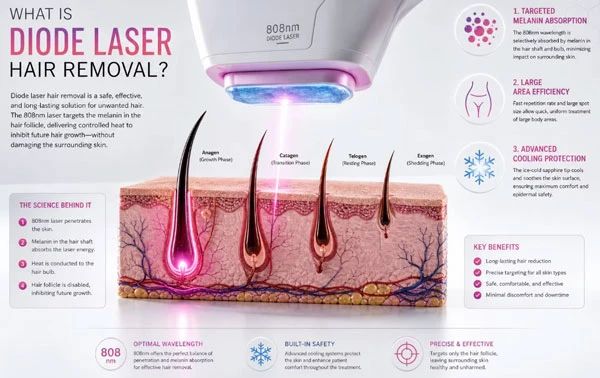
Diode laser hair removal uses concentrated light at specific wavelengths to target melanin in the hair. The absorbed light energy is converted into heat, which damages structures involved in hair growth and helps achieve long-term hair reduction.
Professional diode laser systems commonly operate around 800–810 nm, although some machines offer additional wavelengths, such as 755 nm and 1064 nm, in a multi-wavelength configuration.
The main advantages of diode laser technology include:
Targeted energy delivery to pigmented hair follicles.
Suitability for treating both small and large body areas.
Applications across a range of skin tones when the device and settings are appropriate.
Adjustable treatment parameters for different hair and skin characteristics.
Cooling systems designed to improve comfort and help protect the skin.
Diode laser hair removal is commonly used on the face, underarms, arms, legs, back, chest, and bikini line. Multiple sessions are generally required because hair follicles respond differently at different stages of the growth cycle.
For professional businesses, diode laser equipment can provide a dedicated service for clients seeking long-term hair reduction rather than frequent shaving or waxing.
2. Diode Laser vs IPL Hair Removal
Intense Pulsed Light (IPL) is another common technology used for hair reduction. Although IPL and diode laser systems both use light energy, they differ in how that energy is generated and delivered.
Diode lasers produce light within a relatively narrow wavelength range. IPL systems produce broad-spectrum pulsed light that is filtered for the intended application.
Key differences
| Feature | Diode Laser | IPL |
|---|---|---|
| Light source | Semiconductor laser | Broad-spectrum pulsed light |
| Wavelength | Relatively narrow and device-specific | Broad spectrum with filters |
| Energy delivery | Concentrated laser energy | Filtered pulsed light |
| Treatment applications | Primarily hair reduction | Hair reduction and selected skin treatments, depending on the device |
| Skin suitability | Depends on wavelength, settings, and skin type | Depends on filters, settings, and skin type |
| Equipment options | Dedicated laser systems and multi-wavelength platforms | Various handheld and professional systems |
Which is better: diode laser or IPL?
For a clinic that wants to offer a dedicated hair reduction service, a professional diode laser may be attractive because it delivers a specific laser wavelength to target pigmented hair.
IPL can be appealing to businesses looking for a versatile platform that supports several light-based applications, provided the equipment is designed and authorized for those uses.
Neither technology is automatically superior in every situation. Results depend on the device's actual output, treatment parameters, operator skill, and client characteristics.
For buyers comparing equipment, it is worth reviewing the manufacturer's technical documentation, cooling design, maintenance requirements, and evidence supporting the intended applications rather than relying on advertised power alone.
3. Diode Laser vs Alexandrite Laser
Alexandrite laser hair removal commonly uses a wavelength of 755 nm. Because melanin absorbs this wavelength relatively strongly, it can be effective for reducing dark hair, particularly in appropriately selected clients with lighter skin.
Diode laser systems commonly use wavelengths around 800–810 nm, while some models combine multiple wavelengths to broaden their treatment options.
Key differences
| Feature | Diode Laser | Alexandrite Laser |
|---|---|---|
| Common wavelength | Around 800–810 nm | 755 nm |
| Melanin absorption | Effective absorption by pigmented hair | Higher melanin absorption at 755 nm |
| Typical applications | Hair reduction across a range of suitable skin types | Hair reduction, often particularly useful for lighter skin |
| Darker skin tones | Requires suitable device selection and conservative parameters | Greater epidermal melanin absorption can increase risk |
| Treatment choice | Depends on device design and client assessment | Depends on skin tone, hair characteristics, and clinical judgment |
Which is better for different skin types?
Alexandrite lasers can be a good option for suitable clients with lighter skin and dark hair. However, the higher melanin absorption at 755 nm can also increase the risk of epidermal injury in more deeply pigmented skin.
Diode lasers may offer a useful balance of penetration and melanin absorption for a wider range of clients, depending on the device and treatment settings. A multi-wavelength machine does not automatically guarantee suitability for every skin type.
For clinics serving diverse clients, the most important consideration is whether the equipment has been appropriately designed and validated for the intended skin types and whether operators have the training needed to use it safely.
4. Diode Laser vs Nd Laser
Nd laser hair removal typically uses a wavelength of 1064 nm. This wavelength penetrates more deeply into the skin and is absorbed less strongly by epidermal melanin than shorter hair removal wavelengths.
For this reason, long-pulsed 1064 nm Nd systems are often considered when treating clients with darker skin tones.
Key differences
| Feature | Diode Laser | Long-Pulsed Nd Laser |
|---|---|---|
| Common wavelength | Around 800–810 nm | 1064 nm |
| Penetration | Device- and wavelength-dependent | Generally deeper |
| Epidermal melanin absorption | Higher than 1064 nm at comparable conditions | Lower than shorter wavelengths |
| Common use | Hair reduction in appropriately selected clients | Hair reduction, including selected clients with darker skin |
| Hair characteristics | Often effective on coarse, dark hair | Can be useful for coarse, dark hair, especially in darker skin |
Which technology is better for darker skin?
A properly selected long-pulsed 1064 nm Nd system is often preferred for clients with darker skin because it reduces, but does not eliminate, the risk associated with epidermal melanin absorption.
Certain diode systems may also be appropriate for darker skin when used with validated parameters, suitable pulse durations, and effective cooling.
The correct choice depends on the specific device, skin pigmentation, recent tanning, hair characteristics, and operator expertise. Neither wavelength makes treatment risk-free.
Clinics should follow the manufacturer's instructions, conduct appropriate assessments, and consider test spots when indicated.
5. Diode Laser vs Electrolysis
Electrolysis uses a fine probe inserted into an individual hair follicle. Electrical energy is applied to damage the follicle's growth-producing structures.
Unlike light-based hair removal, electrolysis does not rely on melanin in the hair. This makes it useful for hair colors that respond poorly to conventional laser hair reduction.
Key differences
| Feature | Diode Laser | Electrolysis |
|---|---|---|
| Treatment method | Light energy targets pigmented hair structures | Electrical energy treats individual follicles |
| Suitable hair colors | Best results generally occur with dark, pigmented hair | Can treat white, gray, blonde, red, and dark hair |
| Treatment area | Suitable for relatively large areas | Individual follicles are treated one at a time |
| Speed on large areas | Generally faster for broad coverage | Usually slower for large areas |
| Treatment course | Multiple sessions are needed | Multiple sessions are needed |
| Long-term outcome | Long-term hair reduction | Can achieve permanent removal of successfully treated follicles |
Which is better for permanent hair removal?
Electrolysis can permanently remove individual hairs when follicles are successfully treated. Diode laser treatment is generally intended to achieve long-term hair reduction rather than guarantee permanent removal of every hair.
For clients with dark hair who want to treat larger areas, diode laser treatment may be more practical. For isolated white, gray, or very light-colored hairs, electrolysis may be a more suitable option.
Some clinics offer both services to address different client needs.
6. Diode Laser vs Waxing
Waxing removes hair from the root by applying wax to the skin and pulling away the hair. It is a familiar hair removal method that requires relatively little equipment investment.
However, waxing does not selectively damage hair follicles to produce long-term hair reduction. Hair typically grows back, so clients need regular appointments to maintain the result.
Key differences
| Feature | Diode Laser | Waxing |
|---|---|---|
| Method | Light-based follicular treatment | Mechanical removal of hair |
| Results | Long-term hair reduction after a course of treatments | Temporary hair removal |
| Maintenance | May require occasional maintenance sessions | Requires repeated treatments |
| Initial investment | Professional equipment and training | Relatively low equipment cost |
| Treatment speed | Efficient for many large areas | Depends on area and technique |
| Client considerations | Requires skin and hair assessment | Can cause discomfort, irritation, or ingrown hairs |
Why do some clients choose diode laser treatment?
Clients who experience frequent shaving or waxing may prefer laser hair reduction because it can reduce hair growth over time and lower the need for repeated temporary treatments.
However, diode laser treatment requires an upfront commitment to multiple sessions, suitable hair pigmentation, and professional assessment. Waxing remains a practical option for clients who want immediate temporary hair removal or are not suitable candidates for laser treatment.
7. Diode Laser vs Shaving
Shaving is one of the simplest ways to remove unwanted hair. It cuts the hair at the skin's surface without targeting the follicle.
Its advantages include convenience, low cost, and immediate results. Its limitations are equally straightforward: hair regrowth is expected, and some clients experience razor bumps, irritation, or ingrown hairs.
Diode laser treatment takes a different approach by targeting pigmented hair structures beneath the skin. It requires more time, investment, and professional oversight, but can reduce the frequency and amount of regrowth over time.
For clinics, this distinction provides a clear way to explain the value of professional laser hair reduction services to clients who are tired of maintaining results through daily or weekly shaving.
8. Comparison of Popular Hair Removal Technologies
The following overview summarizes the main differences for professional equipment buyers.
| Technology | Main advantage | Main limitation | Suitable business application |
|---|---|---|---|
| Diode laser | Dedicated laser hair reduction with efficient coverage | Requires suitable hair pigmentation and trained operation | Salons, aesthetic clinics, medical spas |
| IPL | Versatile light-based platform for selected applications | Results and suitability vary considerably by device | Beauty businesses seeking multiple light-based services |
| Alexandrite laser | Strong melanin absorption at 755 nm | Greater epidermal melanin absorption can limit use on darker skin | Clinics serving appropriately selected clients |
| Nd laser | Lower epidermal melanin absorption at 1064 nm | May be less comfortable or less efficient in some treatment situations | Clinics treating a range of skin tones, including darker skin |
| Electrolysis | Can treat hair regardless of color | Time-consuming for large areas | Hair removal specialists and electrolysis studios |
| Waxing | Low initial investment and immediate temporary results | Requires frequent repeat treatments | Traditional beauty salons |
| Shaving | Convenient and inexpensive | Very short-term results | At-home hair removal |
No technology is best for every client. The appropriate option depends on hair color, skin tone, treatment area, budget, service expectations, and the practitioner's qualifications.
9. What Should Clinics Consider When Buying a Diode Laser Hair Removal Machine?
For a professional salon or aesthetic clinic, selecting a machine should involve a review of its performance, usability, maintenance requirements, and suitability for the intended market.
Wavelength configuration
Check the actual wavelength or wavelengths supplied by the device. A multi-wavelength system may provide additional flexibility, but each configuration should be assessed according to its documented performance and intended use.
Cooling performance
Cooling is an important part of laser hair removal. Depending on the design, a system may use contact cooling, integrated cooling, or another approved approach. Ask the supplier how the cooling system works and what maintenance it requires.
Handpiece design
Handpiece weight, ergonomics, spot size, and ease of handling affect daily operation. A suitable spot size can help practitioners work efficiently across different treatment areas.
Parameter control
A clear user interface and appropriate parameter adjustments can support a more organized workflow. Preset programs should not replace professional assessment or training.
Reliability and technical support
Review warranty conditions, spare parts availability, repair services, operator training, and technical assistance. These factors are particularly important for businesses that depend on regular appointment bookings.
Regulatory documentation
Check the device's intended use, applicable certifications, and regulatory status in the country where it will be sold or used. CE marking, FDA authorization, and other regulatory requirements are not interchangeable, and claims should be verified for the exact model.
10. NewAngie Diode Laser Hair Removal Solutions for Professional Buyers
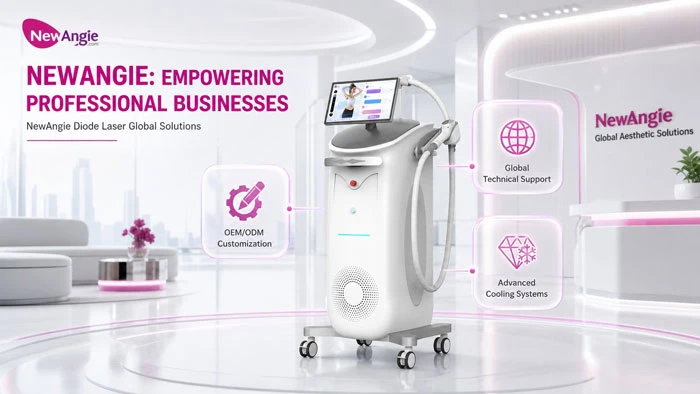
NewAngie supplies professional aesthetic equipment for beauty salons, aesthetic clinics, medical spas, and international distributors. Our diode laser hair removal range includes different configurations to address varying business requirements.
Depending on the model, available features may include:
Different power configurations for professional applications.
Single- or multi-wavelength options.
Touchscreen controls and treatment parameter management.
Cooling systems designed for professional hair reduction.
OEM and ODM customization options, subject to model availability.
When comparing NewAngie diode laser systems with IPL, alexandrite, or Nd equipment, buyers should evaluate the specific technical specifications, intended treatment applications, documentation, and after-sales support.
Our team can help professional buyers identify suitable equipment options for their target market, service menu, and distribution requirements.
Contact NewAngie to request product specifications, discuss customization, and explore diode laser hair removal equipment for your salon, clinic, or distribution business.
Frequently Asked Questions
Is diode laser better than IPL?
Diode laser and IPL use different light technologies. A professional diode laser may be preferable for a dedicated hair reduction service, while IPL can support multiple applications on suitable systems. The best choice depends on the equipment, client population, operator skill, and intended services.
Is diode laser better than Alexandrite laser?
Neither is universally better. Alexandrite laser at 755 nm can be effective for appropriately selected clients with lighter skin and dark hair. Diode laser systems may offer a useful balance for a wider range of clients, depending on the wavelength and treatment parameters.
Is Nd safer than diode laser for dark skin?
A long-pulsed 1064 nm Nd laser is often considered for darker skin because of its lower epidermal melanin absorption. Some diode systems may also be suitable, but the exact device, parameters, cooling, and practitioner expertise determine treatment safety.
Which hair removal technology works on white or gray hair?
Electrolysis is generally a more suitable option for white or gray hair because it does not depend on melanin. Conventional diode laser hair removal usually responds poorly to hair with little or no pigment.
How many diode laser sessions are required?
The number of sessions varies according to the treatment area, hair density, growth cycle, skin characteristics, and device. A course of multiple sessions is normally needed, and some clients require maintenance treatments.
Is diode laser hair removal suitable for every client?
No. Hair pigmentation, skin tone, recent tanning, medications, medical history, and the equipment's intended use all affect suitability. A trained professional should assess each client before treatment.
What is the best hair removal machine for a beauty salon?
The best choice depends on the salon's clients, budget, service goals, training resources, and local regulatory requirements. Clinics seeking a dedicated professional hair reduction service may consider diode laser equipment, while businesses seeking a wider range of light-based applications may evaluate suitable IPL systems.