


How To Choose The Right Tattoo Removal Laser Wavelength
Sep 24, 2026
Leave a message
Choosing the correct tattoo removal laser wavelength is one of the most important decisions in laser tattoo treatment. Tattoo ink is not a single substance, and different pigments respond differently to specific wavelengths of laser energy. A wavelength that works well for black ink may not be the appropriate choice for red, orange, green, blue, or purple pigments.
For professional clinics, dermatology practices, medical spas, and tattoo removal specialists, understanding the relationship between laser wavelength, tattoo ink color, skin type, pigment depth, pulse duration, and treatment parameters is essential for selecting an appropriate laser platform.
The most commonly discussed wavelengths for tattoo removal include 532 nm, 694 nm, 755 nm, and 1064 nm. Modern picosecond and Q-switched systems may offer several of these wavelengths in one platform, allowing practitioners to approach multicolor tattoos with a more flexible treatment strategy.
The key principle is straightforward: the wavelength should be selected according to the optical characteristics of the tattoo pigment while minimizing unnecessary absorption by surrounding skin.
Why Does Tattoo Removal Require Different Laser Wavelengths?
Tattoo ink particles absorb light differently depending on their color and chemical composition. Laser tattoo removal relies on selective absorption of laser energy by the pigment, followed by fragmentation of the ink particles. The body's natural clearance mechanisms then gradually remove or transport the fragmented material.
This is why there is no single wavelength that is universally ideal for every tattoo.
For example, 1064 nm Nd is widely used for black and dark blue tattoo pigments, while 532 nm is commonly used for red, orange, and some purple pigments. 755 nm alexandrite has been used for black, blue, and green pigments, particularly when shorter-wavelength alternatives are not the preferred option.
The choice becomes more complicated when a tattoo contains several colors. A multicolor tattoo may require more than one wavelength during a treatment course rather than attempting to treat every pigment with the same setting.
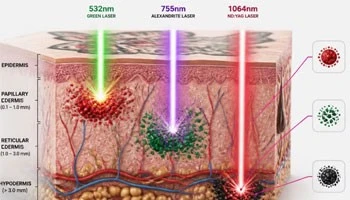
Tattoo Removal Laser Wavelength Chart
| Laser Wavelength | Common Laser Source | Common Tattoo Pigments | Typical Role |
|---|---|---|---|
| 532 nm | Frequency-doubled Nd / KTP | Red, orange, some purple/yellow pigments | Superficial warm-color pigments |
| 694 nm | Ruby | Black, blue, green | Selected darker/cool pigments |
| 755 nm | Alexandrite | Black, blue, green | Cool colors and selected dark pigments |
| 1064 nm | Nd | Black, dark blue | Deep dark pigments |
| 785 nm | Ti in some picosecond platforms | Selected cool colors | Emerging complementary option |
| 1064 + 532 nm | Q-switched or picosecond Nd | Multiple pigment colors | Versatile combination platform |
The actual treatment parameters cannot be determined from wavelength alone. Pulse duration, fluence, spot size, repetition rate, skin phototype, pigment concentration, tattoo depth, and clinical endpoint all influence treatment selection. Recent clinical reviews emphasize that these parameters need to be considered together rather than treating wavelength as an isolated specification.
1064 nm: A Key Wavelength for Black Tattoo Removal
1064 nm Nd is one of the most established wavelengths in professional tattoo removal.
It is particularly useful for black and dark blue tattoo pigments and penetrates relatively deeply compared with shorter wavelengths. This makes it valuable when the target pigment is located deeper within the dermis.
Clinical literature has demonstrated the effectiveness of Q-switched 1064 nm Nd for blue-black tattoos. One prospective study found substantial improvement after several treatment sessions, with continued treatments producing further clearance.
Another important consideration is skin pigmentation. Because 1064 nm is less strongly absorbed by epidermal melanin than shorter visible wavelengths, it is commonly considered when treating darker skin types. However, that does not mean that treatment is automatically risk-free. Skin type, fluence, pulse duration, cooling, treatment history, and the individual's response still need to be considered.
A recent review of laser use in skin of color highlights the importance of conservative parameter selection and careful monitoring because darker skin contains more competing epidermal melanin and may have a greater risk of pigmentary complications.
When is 1064 nm commonly selected?
We generally associate 1064 nm with:
Black tattoo ink
Dark blue tattoo ink
Deeply deposited dark pigments
Selected blue-black permanent makeup pigments
Patients where epidermal melanin absorption needs to be considered carefully
For clinics purchasing a tattoo removal machine, a reliable 1064 nm Nd platform is therefore an important consideration when dark tattoo removal represents a major part of the treatment menu.
532 nm: A Common Choice for Red Tattoo Pigments
532 nm is a frequency-doubled wavelength derived from 1064 nm Nd technology. It is strongly associated with the treatment of red, orange, and selected purple tattoo pigments.
Compared with 1064 nm, 532 nm is more strongly absorbed by certain superficial pigments. This makes it useful when the target ink has an appropriate absorption profile.
Clinical reports have documented the use of 532 nm picosecond systems for difficult pigments, including yellow tattoo ink in selected cases.
However, shorter wavelengths also interact more strongly with melanin. Consequently, patient skin type and treatment parameters become particularly important when using 532 nm.
Common 532 nm tattoo applications include:
Red tattoo ink
Orange tattoo ink
Some purple pigments
Selected yellow pigments
Certain cosmetic tattoo pigments
For a professional clinic, having both 532 nm and 1064 nm can provide considerably more flexibility than relying on a single wavelength.
755 nm Alexandrite for Blue and Green Tattoo Ink
755 nm alexandrite has a long history in tattoo removal, especially for black, blue, and green pigments.
Research on Q-switched 755 nm alexandrite demonstrated effective removal of black and blue-black tattoo pigment, although treatment generally requires multiple sessions.
Modern picosecond systems have also expanded the use of 755 nm for difficult cool-colored pigments.
DermNet notes that picosecond systems using Nd wavelengths such as 532 and 1064 nm, as well as alexandrite at 755 nm, can be selected according to the tattoo pigment being treated.
For clinics that frequently encounter green, blue, and complex multicolor tattoos, a platform offering a suitable wavelength in this range can therefore add another treatment option.
Why Multicolor Tattoos Usually Need Multiple Wavelengths
A tattoo containing black, red, blue, green, orange, and purple ink cannot necessarily be treated effectively with one wavelength.
Consider a tattoo containing:
Black outlines
Red flowers
Blue shading
Green leaves
Orange highlights
A practitioner may need to select different wavelengths for different pigment areas.
A simplified treatment strategy might involve:
1064 nm → black and dark blue
532 nm → red and orange
755 nm → selected blue and green pigments
This does not mean that every tattoo requires all three wavelengths. The appropriate selection depends on the actual ink formulation, depth, skin type, previous treatments, and observed clinical response.
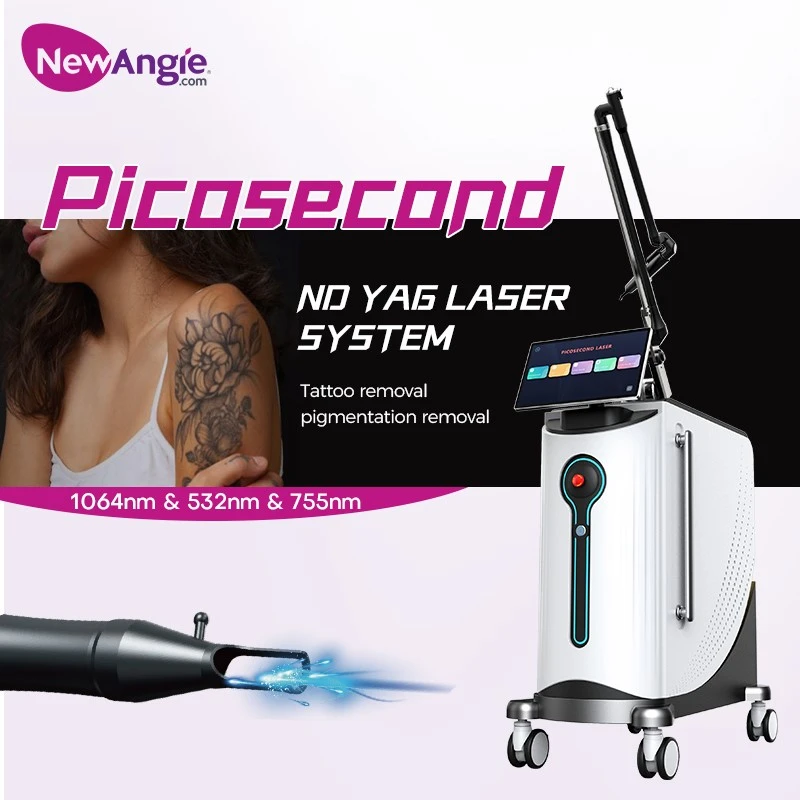
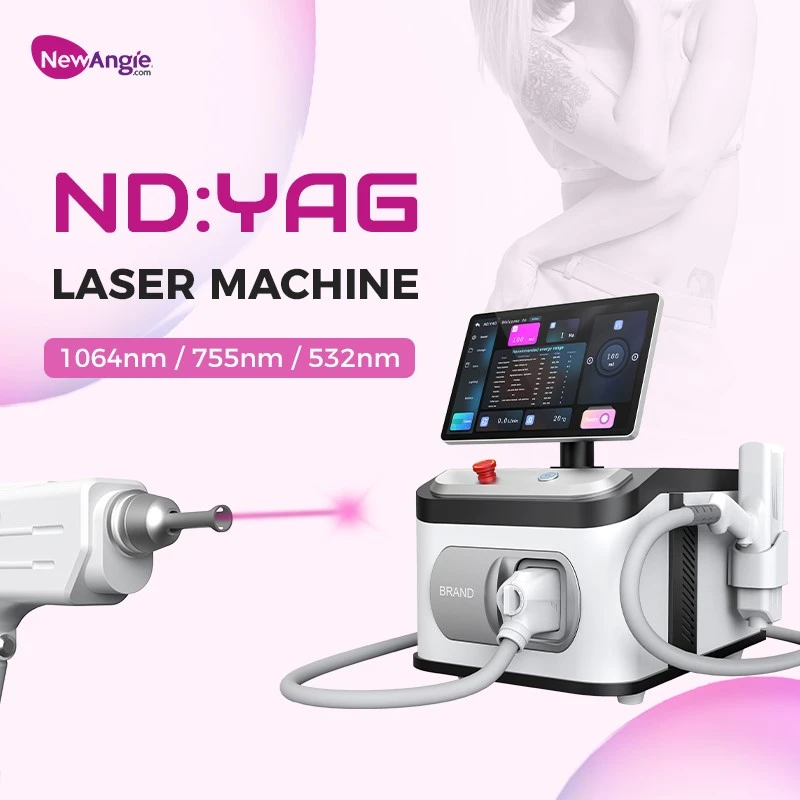
This is one reason multi-wavelength tattoo removal machines can be attractive to professional clinics. Instead of purchasing separate platforms for different pigment families, one system may provide several wavelength options through interchangeable or integrated handpieces.
Picosecond vs Q-Switched: Does Wavelength Still Matter?
Yes.
A common misconception is that moving from a Q-switched laser to a picosecond laser eliminates the importance of wavelength. It does not.
Wavelength determines which pigment can efficiently absorb the laser energy, while pulse duration influences how that energy is delivered to the pigment.
Picosecond lasers deliver extremely short pulses, and their use in tattoo removal has expanded because short pulse durations can create strong photomechanical effects on pigment particles.
DermNet describes picosecond systems as devices using very short pulses to target tattoo ink and notes that different platforms may use 532 nm, 1064 nm, or 755 nm wavelengths.
Current literature also emphasizes that wavelength and pulse duration are related but not interchangeable concepts. A picosecond device still needs an appropriate wavelength for the pigment being targeted.
How Skin Type Changes Wavelength Selection
Tattoo pigment is not the only chromophore absorbing laser energy. Melanin in the patient's skin can also interact with laser light.
This becomes particularly important when treating patients with darker skin phototypes.
Shorter wavelengths can have stronger interactions with epidermal melanin, which may increase the risk of unwanted pigmentary changes if parameters are not appropriately selected.
For this reason, treatment planning should consider:
Fitzpatrick skin type
Natural pigmentation
Recent sun exposure
Tattoo color
Tattoo depth
Previous laser treatments
Treatment interval
Fluence
Spot size
Pulse duration
Cooling strategy
Observed clinical endpoint
A recent review specifically highlights the importance of cautious parameter selection and photoprotection for laser procedures in Fitzpatrick IV–VI skin types.
Do Not Choose a Tattoo Removal Machine Based on Wavelength Alone
For clinics evaluating professional tattoo removal equipment, wavelength is important, but it should be considered alongside the complete laser architecture.
We recommend evaluating the following specifications.
1. Available Wavelengths
A machine with 1064 nm + 532 nm can cover a broad range of common tattoo pigments.
A platform that additionally offers 755 nm can provide another option for selected blue and green pigments.
2. Pulse Duration
Q-switched nanosecond and picosecond systems deliver energy differently.
The appropriate pulse duration depends on the technology, pigment characteristics, treatment objective, and clinical protocol.
3. Energy and Fluence Control
The ability to adjust energy precisely is important for individualized treatment.
A machine should provide sufficiently flexible parameter adjustment rather than relying on a single fixed output.
4. Spot Size Options
Different tattoo sizes and treatment areas may require different spot sizes.
A practical professional system should make it possible to adapt the treatment area to the tattoo rather than forcing every procedure into one spot configuration.
5. Cooling
Cooling can improve treatment comfort and help manage thermal effects on the skin. It should be considered part of the overall treatment system rather than an optional afterthought.
6. Handpiece Design
For busy clinics, the ergonomics of the handpiece can influence treatment efficiency.
A professional tattoo removal platform should allow the practitioner to accurately position the beam over the intended treatment area.
How Many Sessions Are Needed for Tattoo Removal?
There is no universal number of sessions.
Tattoo removal depends on factors including:
Ink color
Ink density
Tattoo depth
Tattoo age
Professional versus amateur tattoo
Tattoo size
Location on the body
Skin phototype
Previous treatment
Individual immune and clearance response
DermNet notes that tattoo removal commonly requires multiple sessions, often in the range of 5–12 treatments, with intervals between treatments, and that complete clearance is not always possible.
Therefore, professional treatment planning should avoid promising complete removal after a fixed number of sessions.
What About Difficult Tattoo Colors?
Some colors can be particularly challenging.
Green
Green pigments may respond to 755 nm in appropriate circumstances, while treatment selection depends heavily on the specific pigment formulation.
Blue
Blue may respond to 1064 nm or 755 nm, depending on pigment composition and clinical circumstances.
Red
532 nm is commonly associated with red tattoo pigments.
Yellow
Yellow can be difficult because its optical characteristics vary considerably. Recent case literature has reported successful treatment of yellow tattoo pigment with 532 nm picosecond treatment, but this should not be interpreted as evidence that every yellow tattoo will respond in the same way.
White and Flesh-Colored Ink
These pigments require particular caution because cosmetic and light-colored tattoo formulations can contain compounds such as titanium dioxide or iron oxides. Some pigments may behave unpredictably under laser exposure, including potential darkening.
For this reason, test spots and careful clinical assessment can be particularly important for unusual cosmetic pigments.
What Is the Best Tattoo Removal Wavelength?
There is no single best wavelength for every tattoo.
A more useful approach is to match the wavelength to the tattoo pigment, skin characteristics, pigment depth, and laser platform.
As a general reference:
1064 nm: commonly selected for black and dark blue pigments
532 nm: commonly selected for red, orange, and some purple pigments
755 nm: commonly used for selected black, blue, and green pigments
694 nm: historically used for black, blue, and green pigments
785 nm: an emerging complementary option for selected cool-colored pigments, with current evidence still more limited than for established wavelengths
The important point is that wavelength should be matched to pigment absorption rather than selected simply because a machine has a particular wavelength.
Choosing a Professional Multi-Wavelength Tattoo Removal Machine
For a clinic, medical spa, or tattoo removal business, a multi-wavelength Q-switched or picosecond laser can provide greater flexibility when treating a varied client base.
A professional system may combine:
1064 nm + 532 nm
or, depending on the platform:
1064 nm + 532 nm + 755 nm
This allows practitioners to select different wavelengths according to the color and depth of the tattoo rather than attempting to use one wavelength for every case.
When comparing machines from different manufacturers, we recommend looking beyond the wavelength list and checking actual output stability, pulse technology, energy adjustment, spot-size options, cooling, handpiece ergonomics, user interface, maintenance requirements, training, warranty, and after-sales technical support.
For distributors and aesthetic equipment suppliers, these factors also influence the long-term usability of the machine for professional customers.
Final Guide to Tattoo Removal Laser Wavelength Selection
The right tattoo removal laser wavelength is determined by the relationship between the laser and the tattoo pigment.
1064 nm Nd remains an important option for black and dark blue tattoos, particularly when deeper pigment and skin pigmentation are considerations. 532 nm provides an important option for red, orange, and selected warm-colored pigments. 755 nm offers another established wavelength for selected black, blue, and green pigments. Picosecond technology adds another dimension through extremely short pulse durations, but it does not remove the need for appropriate wavelength selection.
For professional tattoo removal practices, the most practical approach is therefore not to ask, "Which wavelength is the best?" but rather:
"Which wavelength is appropriate for this pigment, this skin type, and this laser platform?"
That approach provides a more realistic foundation for safe and effective treatment planning and for selecting professional tattoo removal equipment.
Clinical safety note: Tattoo removal is a professional laser procedure. Wavelength selection, fluence, pulse duration, spot size, treatment intervals, and clinical endpoints should be determined by appropriately trained practitioners according to the device instructions, applicable regulations, and individual patient assessment. Complications can include blistering, pigmentary changes, scarring, infection, and other adverse reactions.