


12D HIFU Vs. 7D/4D: Is A Higher Number Always Better For Your Clinic?
Aug 25, 2026
Leave a message
Medical aesthetics industry is currently witnessing a "numbers race" in HIFU technology. From the early 4D systems to the popular 7D MMFU, and now the advanced 12D platforms, professionals and patients alike are left wondering: does a higher number truly equate to superior clinical results? While the digits represent significant technological milestones, the answer lies in the precision, speed, and comfort of the delivery system.
1. Understanding the HIFU Evolution: From 4D to 12D
To understand the 12D advantage, one must first look at how the technology has matured over the past decade.
1.1 The Legacy of 4D and 7D Systems
Traditional 4D HIFU introduced the concept of multi-line firing, allowing practitioners to treat a wider area per shot compared to original single-line devices. 7D HIFU took this further by introducing Micro and Macro Focused Ultrasound (MMFU), which allowed for different focal points for both face lifting and body contouring.
1.2 The 12D Paradigm Shift
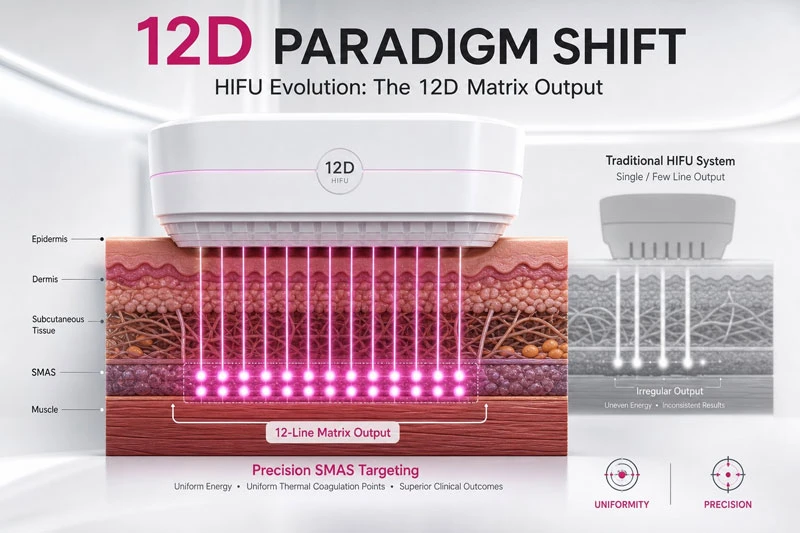
12D HIFU represents the latest iteration, focusing on the "Matrix Output" principle. Unlike older systems that may suffer from uneven energy distribution when firing multiple lines, 12D systems utilize advanced transducers to ensure every one of the 12 lines delivers a uniform thermal coagulation point (TCP) to the targeted tissue.
2. 12D vs. 7D/4D: What Truly Sets Them Apart?
The difference is not just about the number of lines; it is about the quality of the treatment experience and the clinical outcome.
2.1 The Technology Behind the Numbers
2.1.1 Multi-Line Precision vs. Traditional Firing
While 4D systems can fire up to 11 or 12 lines, the speed and spacing were often limited by older processing chips. 12D HIFU employs a high-speed digital scanning system. This allows for tighter, more precise matrix patterns, ensuring that the SMAS (Superficial Muscular Aponeurotic System) layer is tightened evenly without "dead zones" between the ultrasound pulses.
2.1.2 Treatment Speed and Clinic Efficiency
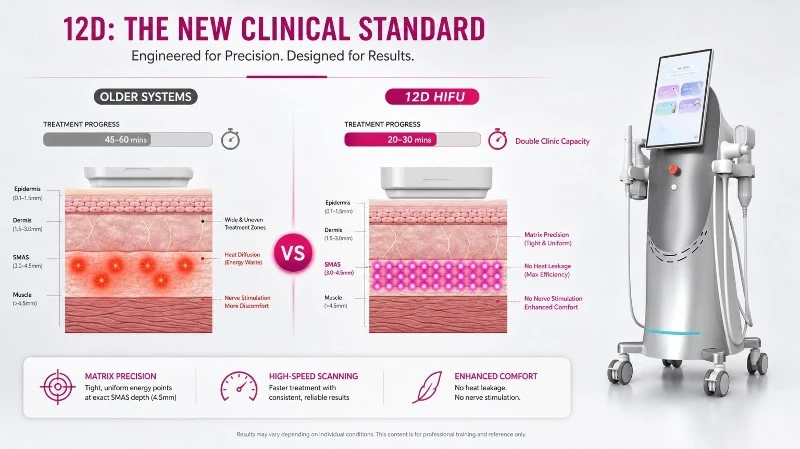
For a busy clinic, time is the most valuable asset. A traditional full-face 4D treatment could take 45 to 60 minutes. Because 12D HIFU fires 12 lines with a faster reset time between shots, practitioners can complete the same procedure in 20 to 30 minutes. This effectively doubles the clinic's capacity to see patients during peak hours.
2.2 Patient Experience: Pain Management and Comfort
2.2.1 Pulse Width and Nerve Stimulation
The most common complaint about older HIFU systems is the "bone-aching" pain. 12D technology addresses this by utilizing shorter pulse widths. By delivering the energy faster, the heat reaches the SMAS layer before the surface nerves can fully register the discomfort, making it a much more tolerable "no-numbing" procedure for most patients.
2.2.2 Reduced Thermal Diffusion
Older systems often caused excessive heat to diffuse into surrounding tissues, leading to prolonged redness or swelling. The 12D's micro-focal sensors ensure that heat remains localized at the target depth (e.g., 4.5mm for the SMAS), protecting the epidermis and reducing downtime.
3. Why 12D HIFU is the Strategic Choice for Modern Clinics
Beyond the technical specifications, 12D HIFU offers a clear competitive advantage in a saturated market.
3.1 Boosting Clinic ROI (Return on Investment)
By reducing treatment time and improving patient comfort, clinics see a higher rate of patient retention and word-of-mouth referrals. The ability to market a "Pain-Free, 20-Minute Facelift" is a powerful tool for attracting the modern, time-conscious demographic.
3.2 Clinical Versatility Across the Body
Newangie's 12D HIFU platforms are equipped with diverse cartridges ranging from 1.5mm to 13mm. This allows clinics to offer a "Head-to-Toe" menu:
Face: Forehead lifting, jawline definition, and periorbital wrinkle reduction.
Body: Post-pregnancy abdominal tightening, arm contouring, and thigh smoothing.
4. Quality Beyond the Digits
While the "12D" label is a useful indicator of the latest technology generation, clinic owners should prioritize the stability of the device and the reliability of the manufacturer. Newangie emphasizes that a high-performance 12D system is not just about the lines on the screen-it is about the engineering of the transducer and the standardized clinical protocols that ensure safety.
Choosing 12D HIFU means choosing efficiency, patient comfort, and the ability to deliver visible regenerative results that keep your practice at the forefront of the medical beauty industry.